


ROBROS Develops In-House Humanoid AI… Targets Open-Source Release Next Year
Introduces robot learning technology at NVIDIA AI Day
Validates tasks with ‘IGRIS-C’ after digital twin training
Trains proprietary model with video, simulation, and operational data
[Edaily reporter Shin Young-bin] ROBROS is developing its own artificial intelligence (AI) model for humanoids and is pushing for an open-source release next year. By implementing real-world work environments in virtual space to train robots and then validating the results on actual hardware, the company is preparing for application in industrial settings.
ROBROS announced on the 12th that it presented the status of its humanoid AI technology development and future plans at ‘NVIDIA AI Day Seoul 2026,’ held from the 9th to the 10th.
|
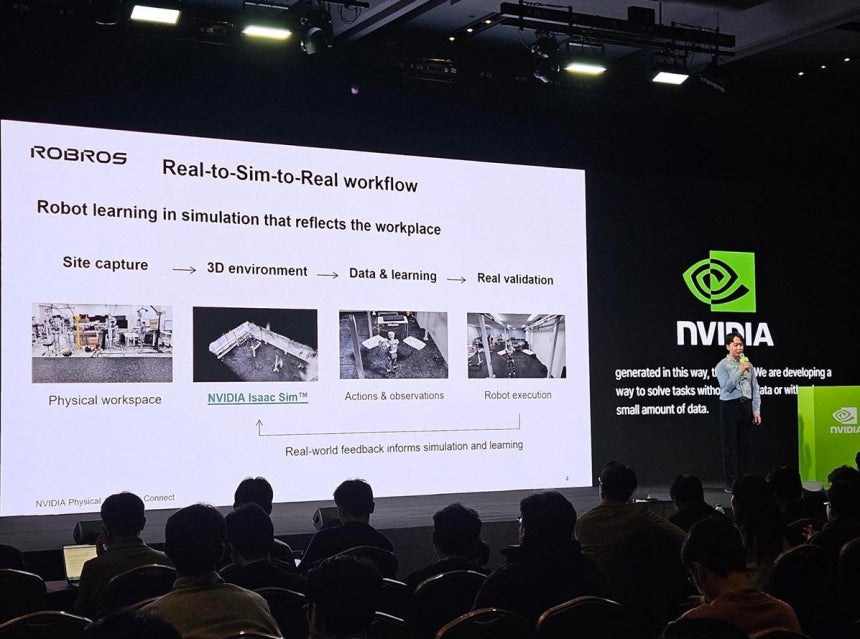
Daegyu Lim, Chief AI Officer (CAIO) of ROBROS, introduced robot learning technology utilizing industrial field data and the company’s proprietary model development strategy at the ‘NVIDIA Physical AI Startup Connect’ session on the 10th.
The presentation focused on ‘Real-to-Sim-to-Real’ technology. Real work environments are recreated as digital twins, robots are trained in simulation, and the results are then applied to and validated on actual robots. ROBROS is building its virtual training environments using NVIDIA’s Isaac Sim, Omniverse, and Isaac Lab.
The company also unveiled a case in which an actual laboratory was reconstructed as a 3D digital twin. After evaluating and training the robot’s task performance in the virtual environment, the work of handling boxes and manufacturing components was validated with its own humanoid ‘IGRIS-C.’ This process serves to check motions ahead of field tests and to compensate for the gap between simulation and reality.
ROBROS is also developing its own robot AI, the ‘World Action Model (WAM).’ Pre-training is underway using simulation data, videos of human work, and actual robot operational data, with the goal of an open-source release in 2027.
ROBROS plans to expand demonstrations in industrial fields such as manufacturing and logistics. The plan is to pursue proprietary AI model development and field data acquisition in parallel to enhance humanoids’ task performance capabilities.
CAIO Lim said, “For humanoid robots to be utilized in actual industrial settings, training data reflecting diverse work environments and the technology to validate it are crucial,” adding, “Based on our own humanoid platform and simulation-based learning technology, we will enhance robots’ task performance capabilities and advance physical AI technology that can be applied in industrial fields.”