


ROBROS Targets Manufacturing and Logistics Industries with Bipedal Humanoid Robots
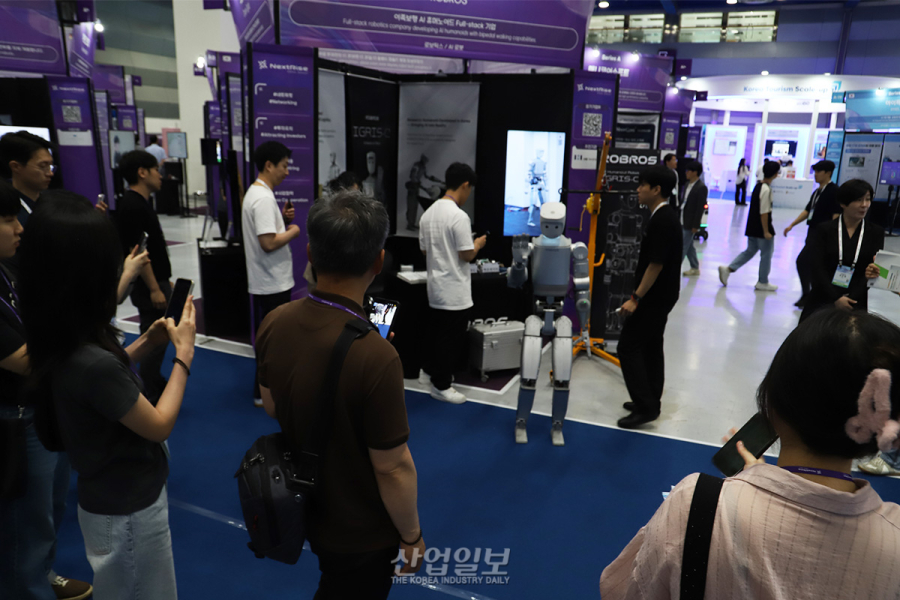
At NextRise 2026, Seoul, ROBROS showcased its humanoid robot IGRIS-C, attracting significant attention from visitors and industry professionals.
Commercialized in November 2025, IGRIS-C was initially developed with service-sector applications in mind. However, growing demand from manufacturing and logistics companies led ROBROS to shift its focus toward industrial use cases. Most of the company’s upcoming proof-of-concept (PoC) projects are currently being planned with partners in the manufacturing and logistics sectors.
To further address industrial requirements, ROBROS plans to launch an upgraded model, IGRIS-C+, in August. While maintaining the same overall design as the current model, IGRIS-C+ will feature a newly developed proprietary actuator designed by ROBROS. The upgrade is expected to increase the robot’s payload capacity from approximately 6 kg to between 15 and 20 kg using both arms.
“Industrial customers place strong emphasis on payload capacity, durability, and whether a robot can meet operational requirements in real-world environments,” said Seungjun Roh, CEO of ROBROS. “The ability to customize robots for specific workplace conditions is also a key factor in adoption decisions.”
Roh added, “Leveraging our in-house design and manufacturing capabilities, we build our robots directly at our headquarters in Seongsu, Seoul, allowing us to respond flexibly to customer-specific requirements. As humanoid hardware and AI technologies continue to advance rapidly, we are accelerating our product development and upgrade cycles to meet market demand.”
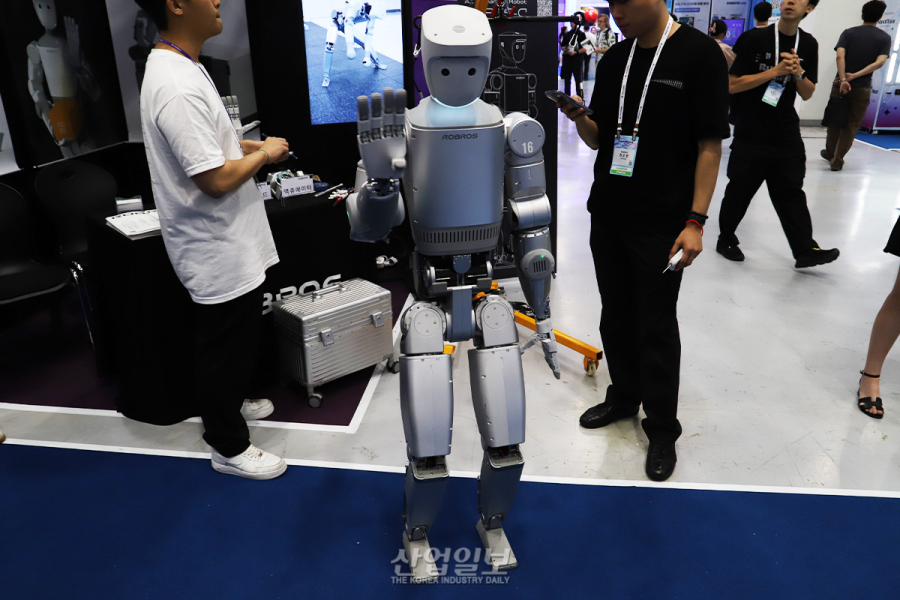
Unlike many humanoid robots recently showcased by Chinese and Korean companies that combine humanoid systems with wheeled AGV and AMR platforms, ROBROS remains committed to bipedal locomotion technology.
Regarding this approach, ROBROS CEO Seungjun Roh said, “Wheeled mobile platforms certainly have advantages in some environments, but many of the industrial sites we have examined are not organized well enough for wheels to move efficiently. Since most facilities are designed around people who walk on two legs, bipedal locomotion is essential for introducing robotic automation without changing existing infrastructure.”
Roh added that while ROBROS’ humanoid robots share similar technical mechanisms with bipedal humanoids developed by global companies such as Boston Dynamics’ Atlas, they target different markets.
“We apply the same sim-to-real approach, using AI reinforcement learning-based locomotion controllers that enable behaviors learned in simulation to be transferred directly to real robots,” he said. “However, hardware requirements vary by industry and work environment. As our primary targets are shipyards and logistics facilities, we do not expect significant overlap with the markets targeted by global robotics companies.”
He added, “ROBROS’ ultimate goal is to move beyond technology demonstrations and develop robots optimized for real industrial environments.”