


ROBROS: "Humanoid AI Model to Be Unveiled in the First Half of Next Year… Starting with Manufacturing and Logistics"
CAIO Daegyu Lim: "Aiming to secure 1 million hours of simulation and video data
"Humanoid robot company ROBROS will unveil its own humanoid artificial intelligence (AI) model in the first half of next year. Rather than a general-purpose humanoid, the company plans to first commercialize a high-performance model that can be used in manufacturing and logistics sites, and then expand its application areas using data gathered in the field.
Daegyu Lim, Chief AI Officer (CAIO) of ROBROS, said in a recent interview with ZDNet Korea, "We plan to unveil our own humanoid AI model in the first half of 2027," adding, "Rather than the model's own benchmark scores, our goal is to make ROBROS' entire humanoid platform perform tasks reliably through to completion at actual industrial sites."
"Cutting development costs by increasing reusability"
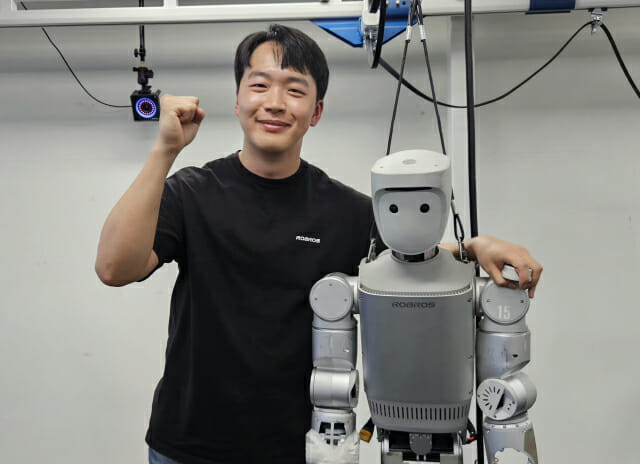
ROBROS focuses on field deployability when evaluating model performance. While noting that "specific performance improvement figures are difficult to disclose as development is still ongoing," CAIO Lim explained, "Rather than simple single-motion success rates, we place importance on long-duration task success rates, recovery capability after the field of view is obstructed, adaptability to new objects and environments, inference latency, and motion smoothness."
The key metric in model development is 'reusability.' Reusability refers to how much of the manipulation and locomotion capability a humanoid learns in one task can be reused in another. CAIO Lim emphasized, "Basic abilities such as grasping, moving, and placing objects must be reusable even when the object type, location, and working environment change — that is where general-purpose value arises," and added, "We will start from concrete industrial tasks such as manufacturing and logistics and gradually broaden the range of verified capabilities."
Cost reduction is also expected. Instead of collecting large volumes of data from scratch every time a new task is introduced, the company aims to reuse already-learned capabilities to significantly lower the data required and deployment costs three years from now.
The full-stack structure of developing hardware and AI together was also cited as a strength. CAIO Lim said, "Since we develop our own hardware and AI together as a full stack, we are optimizing our in-house developed humanoid 'IGRIS' to achieve short inference latency and stable whole-body motion."
CAIO Lim added, "In the long term we aim for a general-purpose humanoid, but in the short term it is important to deploy first at applicable sites and secure data."
For rapid commercialization, ROBROS also takes a flexible approach to robot hand形 configurations. ROBROS does not insist solely on a five-fingered form like the human hand. In the long term, the goal is to continue R&D on five-fingered hands to secure manipulation capabilities close to human level, but for now the policy is to apply humanoids to tasks such as box handling, where even low-degree-of-freedom grippers can deliver sufficient value.
A 'three-axis' data pipeline: teleoperation, simulation, and video
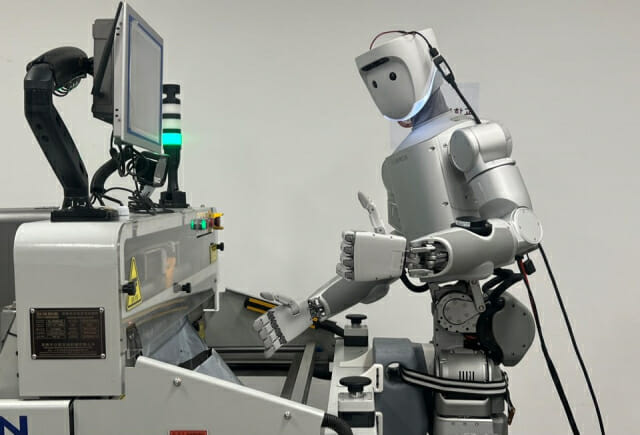
ROBROS has built a three-axis pipeline to secure data. The first is teleoperation data collected by remotely controlling actual robots. CAIO Lim explained, "It is useful for training because it is data obtained from real robots performing tasks, but it has the limitation that volume is hard to scale quickly since a human must directly operate the robot."
The second is synthetic data generated in physics simulation. CAIO Lim said, "ROBROS builds precise models of robots on top of 'Isaac Sim' and is internalizing technology that 3D-scans real environments to create digital twins," adding, "With this technology, we can operate robots precisely and rapidly generate and augment data under desired conditions." He added, "However, there are still limitations with targets that are difficult to simulate, such as deformable bodies, fluids, and organisms." Isaac Sim is NVIDIA's simulation software for creating synthetic data.
The third is first-person-view video data of humans. This approach pre-trains meaningful representations from videos of human work and then fine-tunes with robot data, reducing the amount of actual robot data required.
ROBROS plans to secure a total of 1 million hours of data by the first half of next year, including 800,000 hours of simulation data and 200,000 hours of video data. The company said this scale is on par with what global frontier AI labs hold.
ROBROS aims for the capability to link hardware, control, AI, and data training into a single cycle. To this end, it is building its own software platform that helps even non-experts utilize physical AI — covering data collection, review, editing, training, and inference — in the process of applying real robots and models in the field.
CAIO Lim said, "We are also open to collaboration with domestic on-device AI chip companies that can be integrated with this platform."